
Small businesses gradually adapt to the cyclical economy
From the trend pursued by multinational corporations, the circular economy gradually has the opportunity to succeed in domestic small businesses.
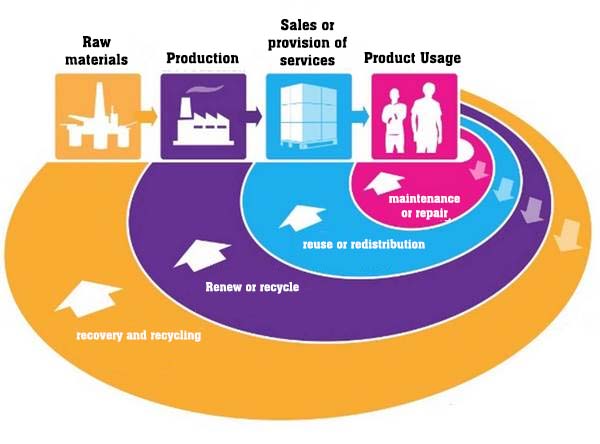
The circular economy has many definitions, but fundamentally it is a model that enhances the reuse, recycling, and recovery of materials in the production, distribution, and consumption process. It is different from the traditional linear economy, where products are produced and discarded after consumption.
Vietnam aims for a circular economy.
In Vietnam, this trend used to be unfamiliar to the majority of businesses. It was mainly implemented by large enterprises, mostly multinational corporations, thanks to their financial and technological capabilities. However, there have been some promising signals in small and medium-sized companies, indicating the potential for economic efficiency.
Faslink, a domestic fashion material supplier, started researching sustainable materials 12 years ago. Six years ago, they established a set of sustainability criteria for the company. And recently, they have delved into the circular economy.
The company currently has a collection of fabrics made from coffee waste, lotus fibers, mint fibers, seashells… and they are exploring the possibility of using banana fibers. CEO Tran Hoang Phu Xuan stated that in the first year of launch, 3 million polo shirts and 200,000 shirts made from coffee waste fabric were sold.
 CEO Tran Hoang Phu Xuan of Faslink holding shirts made from coffee waste fabric. Photo: BSA
Recently, Coteccons has started using a new uniform batch made from sustainable fabrics ordered from Fastlink. Ms. Xuan recognizes the opportunity in the corporate uniform market, where an increasing number of companies desire to use sustainable fabric materials.
In agriculture, Mr. Pham Minh Thien, CEO of Thanh Binh company, is aiming for a circular economy, utilizing everything from straw to rice bran. Straw is used for mushroom cultivation and as feed for cattle. Rice bran is pressed into exportable pellets; golden bran is pressed to extract oil and the residue is used as animal feed. Rice by-products (broken rice, rice husks) are used for flour production.
According to Mr. Thien’s research, the nutritional value of rice bran is equal to half of soybean bran but is absorbed more quickly. Therefore, he promotes the use of rice bran to reduce the import of soybean bran. As a result, the price of rice bran has increased from 900 VND per kg to 9,000 VND. The increased demand has led to the development of the rice bran industry in Sa Dec (Dong Thap).
Recognizing the potential, Mr. Thien has also invested in a plot of land in Tan Hong (Dong Thap) specializing in growing IR50404 rice variety. “This variety has a short growth period, and we don’t use pesticides to reduce cultivation costs and soil contamination. This chain is not for rice consumption but for rice flour exploitation,” he said.
Meanwhile, Mr. Pham Dinh Ngai, CEO of Sokfarm, has utilized coconut areas with declining yields due to saltwater intrusion in Tra Vinh to extract honey and process it into products such as beverages or soy sauce. The revenue from these coconut trees can increase 3-5 times compared to before.
According to Ngai, the circular economy is not a distant concept as his startup is thriving with it. “After three years in this direction, we have gained the interest of many partners and consumers, with high spread and convenient sales, nurturing the business,” Ngai said. Currently, his company provides employment for 70 farmers.

At a seminar in November in Ho Chi Minh City, Associate Professor Dr. Nguyen Hong Quan assessed the significant value of product regeneration, although it is not easy to accomplish. However, there are now units that have achieved it and earned extra money, demonstrating great potential.
According to Dr. Quan, the circular economy is currently facing both advantages and challenges. In terms of advantages, health factors are increasingly valued by both producers and consumers, creating opportunities for sustainable and recyclable products.
However, the challenge lies in how to access the market conveniently at a reasonable price. Ms. Phu Xuan confirmed that the speed of consumer access to circular economy products has increased compared to the past, but the major obstacle is still the cost.
“The issue is how to achieve sustainable production at a reasonable cost. We are striving to ensure that our products are only 30% more expensive than conventional products. To further reduce costs, collaboration among all parties within a circular economy ecosystem is needed,” Ms. Xuan stated.
Solving this problem opens up a great global opportunity. According to Accenture, a global management consulting company (Ireland), transitioning towards a circular economy is estimated to represent a $4.5 trillion global growth opportunity by 2030.
Meanwhile, approximately 90 billion tons of natural resources are extracted each year to support the global economy. Based on current trends, this number is expected to double by 2050. However, only 9% of resources are regenerated into new products after their initial use, according to the United Nations Environment Programme (UNEP).
The long-term opportunity and macro environment are already in place, and the success of businesses depends on their ability to identify a product that meets market demand. “The acceptance of a product depends on its relevance to the market demand. We must identify the right demand to supply,” shared Mr. Thien, based on his experience.
According to Associate Professor Dr. Nguyen Hong Quan, what businesses need to do is maintain their normal economic activities and integrate circular solutions into them. To be effective, integration must consider all input and output variables. Businesses should not overly rely on theory and rigid models.
“In the future, there may be a different definition of a circular economy. The definition may not be too important, but the ultimate goal is sustainable development, a cleaner planet, and happier people,” he said.